
Expanding your business into South Korea? One of the fastest and most effective ways to enter this high-tech, consumer-driven market is by learning how to set up a branch office. Unlike a subsidiary or representative office, a branch allows foreign companies to legally generate revenue—conducting sales, signing contracts, and hiring employees—while operating under the parent company’s name. This structure offers speed and operational control, but it also means the parent bears full legal and financial responsibility.
This step-by-step guide walks you through everything you need to know about establishing a branch office in South Korea, from legal requirements and document preparation to tax compliance and long-term reporting. Whether you’re a U.S.-based tech firm or a European manufacturer, understanding the process ensures a smooth, compliant launch in one of Asia’s most dynamic economies.
Branch vs. Representative Office in South Korea

Can Your Office Generate Revenue?
The key difference lies in function: a branch office can earn income and operate commercially in South Korea. It can invoice clients, hire staff, and sign binding contracts. A representative office, however, is restricted to non-revenue activities like market research, brand promotion, or liaison work with local partners.
Who Bears Legal Liability?
A branch is an extension of the foreign parent company and has no separate legal identity. This means all debts, lawsuits, and obligations fall directly on the parent. A representative office has even fewer rights—it cannot be sued independently but also cannot conduct business.
When to Choose Each Structure
Opt for a branch office if you’re ready to sell, hire, and scale. Use a representative office only for initial market testing. For most foreign businesses planning serious growth, the branch is the logical first step.
Legal Requirements for a South Korea Branch Office
Appoint a Local Resident Representative
You must designate a resident representative—a South Korean national or a foreigner with valid residency in Korea. This person acts as the legal signatory, handles tax filings, and represents the branch in official matters. They do not need to be a director of the parent company but must have formal authority.
Secure a Registered Office Address
A physical or approved virtual office in South Korea is required. This address will receive government notices, tax letters, and legal documents. Residential addresses or P.O. boxes are not acceptable.
Use the Correct Company Name
The branch must operate under the exact legal name of the parent company, followed by “South Korea Branch” in both English and Korean (e.g., “XYZ Ltd. Korea Branch / XYZ 유한회사 한국지점”). Trade names or variations require special approval.
No Minimum Capital, But Funds Must Be Sufficient
South Korea does not require a minimum capital deposit. However, the parent must remit enough funds to support planned operations. The amount should reflect your business scale and be documented during registration.
No Shareholders or Directors Required
Since the branch isn’t a separate entity, there are no shareholder meetings or board appointments. Governance stays with the parent company, but a clear delegation of authority to the local representative is legally necessary.
Documents Needed to Register a Branch in South Korea

Certified Certificate of Incorporation
Provide a certificate of incorporation (or equivalent) issued within the last six months. This proves your parent company is legally registered and active.
Notarisation and Apostille or Legalisation
All foreign documents must be:
- Notarised in the home country
- Apostilled (if your country is part of the Hague Convention)
- Or consular-legalised by the Korean embassy (if not Hague-member)
For example, U.S. documents need notarisation + apostille; Chinese documents require embassy authentication.
Notarised Power of Attorney
Submit a power of attorney authorising the local representative or agent to file registration, open bank accounts, and accept legal notices. This document must also be notarised and legalised.
Official Korean Translations
All non-Korean documents must be translated into Korean. While not always mandatory, authorities may request certified translations—so it’s best to prepare them in advance.
Step-by-Step Process to Establish a Branch in South Korea
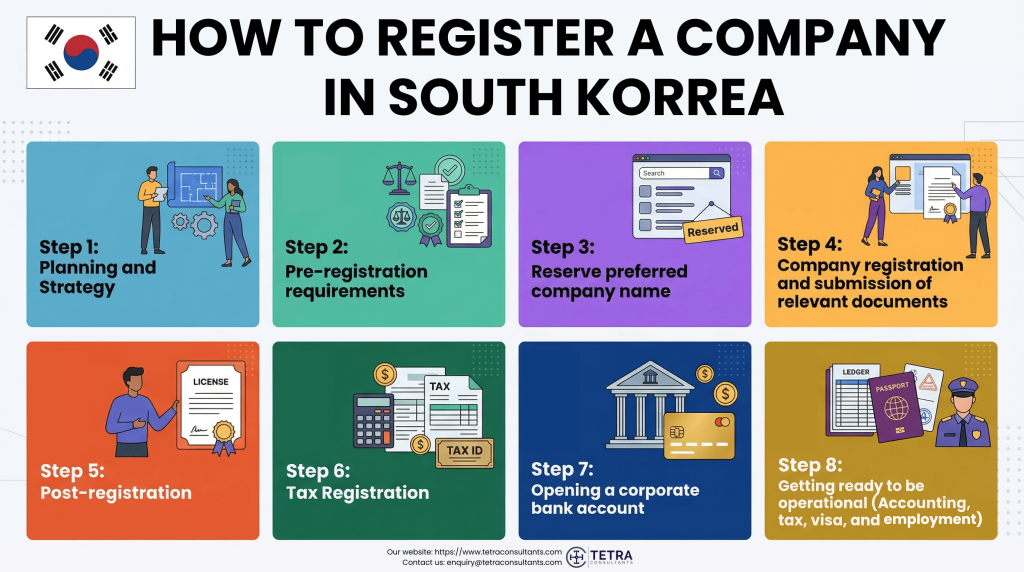
Step 1: File Foreign Investment Notification with a Designated Bank
Submit your documents to a foreign exchange bank (e.g., Woori, KB Kookmin, Shinhan) to notify the Bank of Korea of incoming funds. This allows you to open a temporary capital account for fund remittance.
Required documents:
• Notarised certificate of incorporation
• Legalised power of attorney
• Investment declaration form
Processing time: 1–2 weeks.
Step 2: Register with Tax Office and Court Registry
File your branch registration simultaneously with:
- National Tax Service (NTS) – for business registration number
- District Court Registry Office – for official incorporation record
Submit:
• Branch establishment report
• Representative appointment notice
• Office address confirmation
Step 3: Receive Branch Registration Certificate
Once approved, the court issues a branch registration certificate, confirming your legal presence in Korea. Keep this for banking, visas, and contracts. Processing: 2–3 weeks.
Step 4: Obtain Business Registration Number (BRN)
The NTS assigns a 10-digit BRN, essential for:
• VAT registration
• Payroll and employee reporting
• Invoicing clients and suppliers
You can verify your BRN on the NTS public portal.
Step 5: Open a Permanent Corporate Bank Account
With the registration certificate and BRN, open a corporate bank account in the branch’s name. Most banks require:
• In-person attendance by the local representative
• Original documents
• Company seal registration (if applicable)
Transfer funds from the temporary account. Allow 1–2 weeks for activation.
Tax and Accounting Obligations for Korean Branches
Pay Corporate Income Tax on Local Profits
A branch is taxed only on Korean-source income. The corporate tax rate ranges from 9% to 24%, based on taxable income. An additional 10% municipal income tax applies.
No withholding tax is imposed when profits are sent to the parent—since the branch is not a separate taxpayer.
Register for VAT and File Semi-Annual Returns
If your branch sells goods or services, you must register for VAT (10%). Returns are due every six months—in July and January. Invoices must include your BRN and VAT number.
Exemption applies if annual revenue is under KRW 48 million, but registration becomes mandatory once exceeded.
Maintain Books in Korean Won and Korean Language
All official accounting records must be in Korean won (KRW) and Korean language. You can keep parallel English records, but auditors and tax authorities require Korean-compliant books.
Use either Korean GAAP or K-IFRS standards—foreign accounting methods are not accepted.
Comply with Audit Requirements
If your branch meets any two of the following, a statutory audit is required:
• Total assets > KRW 100 billion
• Annual revenue > KRW 100 billion
• Employees > 300
Audits must be conducted by a licensed Korean accounting firm.
Post-Setup Compliance Timeline and Checklist
First-Year Compliance Deadlines
| Requirement | Deadline |
|---|---|
| First VAT return | End of month after 6-month period |
| Corporate tax return | Within 3 months of fiscal year-end |
| Financial statements | Filed with tax return |
| Employee insurance registration | Within 14 days of first hire |
Ongoing Reporting Obligations
• File annual financial statements with the NTS
• Prepare transfer pricing documentation for related-party transactions
• Submit foreign exchange reports for additional capital inflows
Failure to comply risks fines, penalties, or deregistration.
Common Mistakes When Setting Up a Branch in South Korea
Delaying Document Legalisation
Incomplete notarisation or missing apostilles are the top cause of delays. Some countries take weeks to issue apostilles—start early.
Using an Invalid Office Address
Unapproved virtual offices or residential addresses can lead to rejection. Ensure your address is commercially zoned and verifiable.
Assuming Tax Exemption for Foreign Parent
Even though the branch isn’t a separate legal entity, it is a tax resident in Korea for local income. Assuming you’re exempt leads to back taxes and penalties.
Keeping Books Only in English or Foreign Currency
This violates Korean law. Implement a KRW-based, Korean-language accounting system from day one.
When to Choose a Subsidiary Over a Branch
A Korean subsidiary may be better if you:
• Want limited liability protection
• Plan to raise local capital or list shares
• Need operational independence
• Seek government grants or incentives
A subsidiary is a separate legal entity with its own shareholders and board. Setup is more complex, but offers long-term flexibility and risk protection.
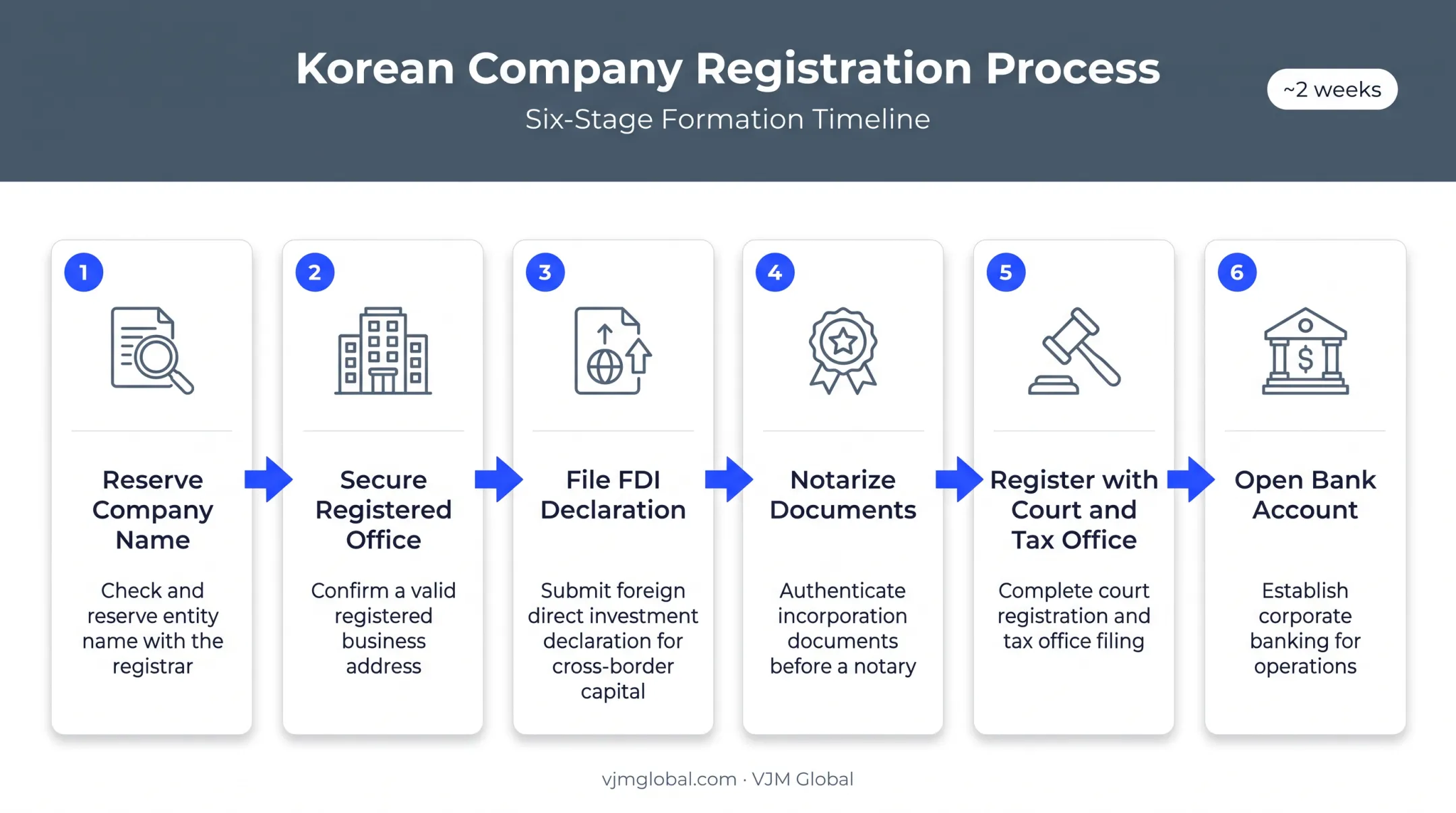
How Long Does It Take to Set Up a Branch in South Korea?
| Step | Duration |
|---|---|
| Document preparation and legalisation | 3–4 weeks |
| Submission and registration | 2–4 weeks |
| Tax registration and BRN issuance | 1–2 weeks |
| Bank account opening | 1–2 weeks |
| Total | 2–3 months |
Timeline depends on document readiness and bank processing speed.
Frequently Asked Questions About Setting Up a Branch Office in South Korea
Can a foreign company open a branch in South Korea?
Yes. Foreign companies can establish a branch office in South Korea to conduct commercial activities, provided they appoint a local representative, secure a registered address, and complete registration with tax and court authorities.
Is a branch office a legal entity in South Korea?
No. A branch is not a separate legal entity—it is an extension of the foreign parent company. The parent bears full legal and financial responsibility for the branch’s operations.
Do I need a visa to manage a branch in South Korea?
Yes. The local representative typically applies for a D-8-2 (Business Manager) visa. Requirements include the branch registration certificate, business plan, and proof of capital remittance.
Can a branch office hire employees in South Korea?
Yes. A registered branch can legally hire local and foreign employees. You must register with the Korea Employment Information Service and enroll staff in national insurance (pension, health, employment, and industrial accident).
Is there a minimum capital requirement for a branch?
No. South Korea does not impose a minimum capital requirement. However, sufficient funds must be remitted from the parent to support operations, and the amount should reflect the business scale.
How are branch profits taxed in South Korea?
Branches pay corporate income tax (9%–24%) on Korean-source income. Profits remitted to the parent are not subject to withholding tax, as the branch is not a separate taxpayer.
Key Takeaways for Setting Up a Branch Office in South Korea
Setting up a branch office in South Korea is a strategic move for foreign companies ready to enter the market with full commercial rights. It allows immediate revenue generation, simplified governance, and faster setup than a subsidiary. However, the parent company assumes full liability, and compliance with Korean tax and accounting rules is mandatory.
To succeed:
• Appoint a qualified resident representative
• Secure a compliant office address
• Complete document legalisation early
• Register with the foreign exchange bank, tax office, and court
• Maintain Korean-language, KRW-based accounting
For companies without local expertise, partnering with a professional services provider like Acclime ensures accurate filings, timely registrations, and ongoing compliance. With the right foundation, your South Korea branch can become a powerful hub for Asia-Pacific growth.



